
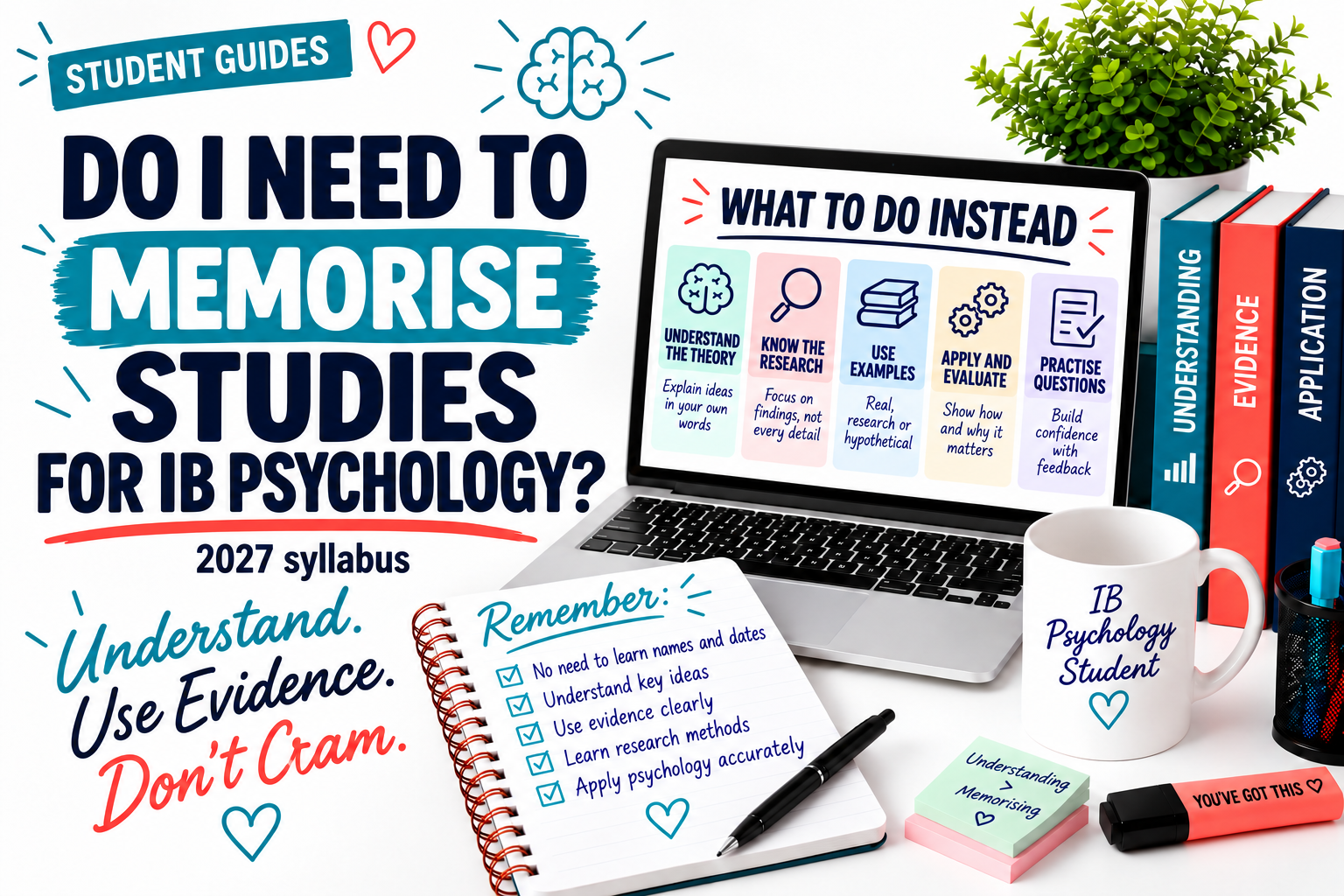
Do I Need To Memorise Studies For IB Psychology? The Short Answer
No! One of the biggest changes to the new IB Psychology syllabus (first assessment 2027) is that you no longer need to memorise the details of lots of research studies.
However, this doesn't mean research is no longer important.
Here's what you need to know:
- You don't need to memorise study details – researchers' names, dates, sample sizes and detailed procedures are no longer something you need to learn for the examinations.
- You still need to understand psychological research – research helps us understand how psychological theories work and provides evidence for psychological claims.
- You can use real or hypothetical examples – particularly in Paper 1 Section A, where examples help demonstrate your understanding of psychological theories and ideas.
- You need to understand research methods – including how research is conducted, its strengths and limitations, and how to evaluate findings.
- Understanding is more important than memorisation – focus on explaining, applying and critically thinking about psychology rather than recalling study details.
So, put away those enormous lists of studies and concentrate on understanding the psychology instead!
Do I Need To Memorise Studies For IB Psychology? The Long Answer
If you've been looking at older IB Psychology revision websites, textbooks or videos, you might have come across advice telling you to memorise dozens of research studies.
You might even have found lists of studies organised by topic, complete with researchers' names, dates, aims, procedures, findings and evaluations.
The good news is that this is no longer necessary for the new IB Psychology course!
Under the previous syllabus, students spent considerable time learning research studies so they could reproduce them in their examinations.
The new syllabus, first assessed in May 2027, has shifted the focus towards understanding psychological knowledge, applying it to unfamiliar situations and thinking critically.
However, I wouldn't recommend throwing away all your research notes just yet!
Research is still an essential part of psychology. You simply need to approach it differently.
Let's look at what has changed and what you should be learning instead.
1. What Has Changed From The Old Syllabus?
Previously, IB Psychology students were expected to support many of their examination answers with specific research studies.
This often meant memorising a large number of studies, including their aims, procedures, findings and methodological strengths and limitations.
Students would then select relevant studies to include in their answers.
While understanding research remains important, the new syllabus does not assess your ability to recall the specific details of individual studies.
Instead, the emphasis is on understanding psychological theories and concepts, applying your knowledge and evaluating psychological research and claims.
For example, if you were answering a question about schema theory, you would need to understand what schemas are and how they influence cognitive processes.
But you would not need to memorise every detail of a particular study investigating schemas.
My advice: Be careful when using revision materials created for the old syllabus. They may still contain useful explanations of psychological theories and research, but the examination advice may no longer be appropriate.
2. Do I Still Need To Use Research Studies In My Answers?
You can, but it depends on the question.
Let's start with Paper 1.
Paper 1 Section A
In Section A, you are asked to describe or explain a psychological theory or idea and provide an example.
This example can be:
- A research study
- A real-life situation
- A hypothetical situation
All three are acceptable, provided the example is relevant and demonstrates your understanding of the psychology.
For example, imagine you are asked to explain schema theory using an example.
You could refer to a study investigating how prior knowledge influences memory.
Alternatively, you could describe a hypothetical situation in which someone remembers details of an event that fit their expectations but overlooks information that doesn't.
Both approaches could be effective.
What matters is that you clearly explain how the example demonstrates schema theory.
You don't gain extra marks simply for remembering a researcher's name or the year a study was conducted.
Paper 1 Section B
In Section B, you are given an unfamiliar situation and asked to apply your psychological knowledge.
The situation is provided for you, so your focus should be on selecting relevant psychological knowledge and explaining how it applies.
You don't need to introduce a memorised research study.
Paper 1 Section C
Section C involves a concept-based extended response question.
Here, you need to develop an argument using your understanding of psychology and the relevant concept.
Research studies and examples can be useful for supporting your discussion, but there is no requirement to include a specific number of studies.
Your priority should be developing a relevant, well-supported argument rather than trying to fit in studies you have memorised.
For more information, read my IB Psychology Paper 1 Guide.
3. What About Papers 2 and 3?
This is where understanding research becomes particularly important.
Paper 2
Section A focuses on the class practicals you have completed during the course.
You need to understand the research methods you used, the decisions you made and the methodological issues involved.
You should know your own practicals well, but you don't need to memorise published research studies to answer these questions.
In Section B, you are given an unfamiliar research study and asked to evaluate it using psychological concepts.
This means you need to be able to identify and discuss issues such as bias, causality, measurement and responsibility.
You are being assessed on your ability to evaluate the research provided, not your ability to recall studies you have previously learned.
Read more in my IB Psychology Paper 2 Guide.
Paper 3 (HL only)
Paper 3 is based on research information provided in the examination.
You need to interpret quantitative and qualitative data, demonstrate your understanding of research methods and considerations, and critically evaluate research claims.
Again, you are not required to recall the details of published studies.
However, you do need a strong understanding of how psychological research works.
Read more in my IB Psychology Paper 3 Guide.
4. Does This Mean I Can Ignore Research Studies Completely?
Absolutely not!
Psychology is a scientific discipline, and our understanding of human behaviour is built upon research.
Research studies help us understand where psychological theories come from, how they have been tested and how convincing the evidence is.
For example, when learning about cognitive biases, research can help you understand how researchers investigate decision-making and what their findings suggest about human thinking.
When learning about social influence, research can help illustrate why people might conform or obey authority.
And when studying biological explanations of behaviour, research helps you understand how scientists investigate relationships between biological processes and psychological outcomes.
You might also find that a particular study provides an excellent example to use in an examination answer.
My advice: Learn the main findings and significance of useful studies rather than attempting to memorise every detail.
Ask yourself:
- What psychological theory or idea does this research investigate?
- What did the researchers find?
- How do the findings help us understand behaviour?
- What are the strengths or limitations of the evidence?
- How could I use this research to support an argument?
These questions will help you develop an understanding of research that is far more useful than memorising names and dates.
5. What Should I Memorise Instead?
Although memorising research studies is no longer necessary, don't assume that the new syllabus requires no memorisation at all.
You still need to learn the psychology!
That includes:
- Key psychological terminology: You need to understand and accurately use terms such as schema, neurotransmitter, conformity and enculturation.
- Psychological theories and explanations: You should be able to explain theories and describe how they help us understand behaviour.
- The six concepts: You need to understand bias, causality, change, measurement, perspective and responsibility, and apply them across different areas of psychology.
- Research methods and terminology: You need to understand experiments, observations, interviews, surveys, sampling, ethics, data analysis and other relevant methodological issues.
- Your class practicals: You should be familiar with what you did, why you did it and how you could evaluate your methodological decisions.
However, I would encourage you to avoid relying entirely on memorising definitions or prepared answers.
Instead, practise explaining your knowledge in your own words and applying it to different situations.
For example, rather than simply memorising the definition of conformity, try explaining why someone might agree with their friendship group even when they privately disagree.
This demonstrates that you understand the psychology rather than simply remembering a definition.
So, What's The Best Way To Revise For IB Psychology?
My recommendation is to spend less time creating enormous sets of research-study flashcards and more time actively using your knowledge.
Here are three things I would encourage you to do.
First, explain psychological theories without looking at your notes.
If you can explain a theory clearly in your own words and give a relevant example, you probably understand it.
Second, practise applying your knowledge to unfamiliar situations.
Make up examples or use scenarios from your lessons. Think about which psychological theories could explain the behaviour and why.
Third, practise evaluating research.
Take a research study and ask yourself how it was conducted, what conclusions can be drawn and what might affect the credibility or validity of the findings.
These are the skills that will help you across the new examinations.
My Final Advice
I think removing the requirement to memorise numerous studies is one of the most positive changes to the new IB Psychology syllabus.
It gives students more opportunity to focus on understanding psychology and developing the skills to think critically about behaviour and research.
However, don't confuse not needing to memorise studies with not needing to know research.
Research remains central to psychology, and understanding it will make you a stronger psychology student.
Remember: You don't need to remember who did every study, when they did it or exactly how many participants they used. You need to understand what psychological research tells us, how we know and why it matters.
And that is a much more useful way to learn psychology!
Need Help With IB Psychology?
Send your question to me at [email protected].
More Student Guides are being added regularly!
Find more Student Guides here.